
Lesson · 6 min Gentle
The Risk Register
In one line A risk register lists each risk with its cause, effect, rating, owner and response, and stays in use.
Once a team can tell risks from issues, it needs somewhere to keep the risks. The usual place is a risk register: a table with one row for each risk. The columns vary, but most registers ask the same things. What might happen, and why? What would it do to the project? How likely is it, and how bad would it be? Who is watching it? What are we doing about it, and by when?
The hardest column is the first. 'Weather' is not a risk; it is a topic. 'Heavy rain in March may flood the foundation trench and stop work for a week' is a risk, because it names a cause, an event and an effect, and so suggests what to do. Gather risks from everyone, not only the planners: the site foreman, the school caretaker, the supplier and the neighbours each see different dangers. Then give each row a rough rating, a named owner and a chosen response.
A register is useful only while it is read. The common failure is a long document drawn up for the approval meeting and never opened again, so that by the third month it describes a project that no longer exists. Another is a register that leaves out the risks that might embarrass someone senior. Keep it short enough to look at: the top ten or so risks reviewed at every team meeting, with new ones added, passed ones closed, and those that have come true moved to the list of issues.
Earlier in the course, Writing Down Your Assumptions listed what a plan takes for granted. Many of those assumptions belong in the register too, since each could turn out false. The next lessons look at how to rate the rows, who should own them and what to do about each.
Sixty-three rows become twelve
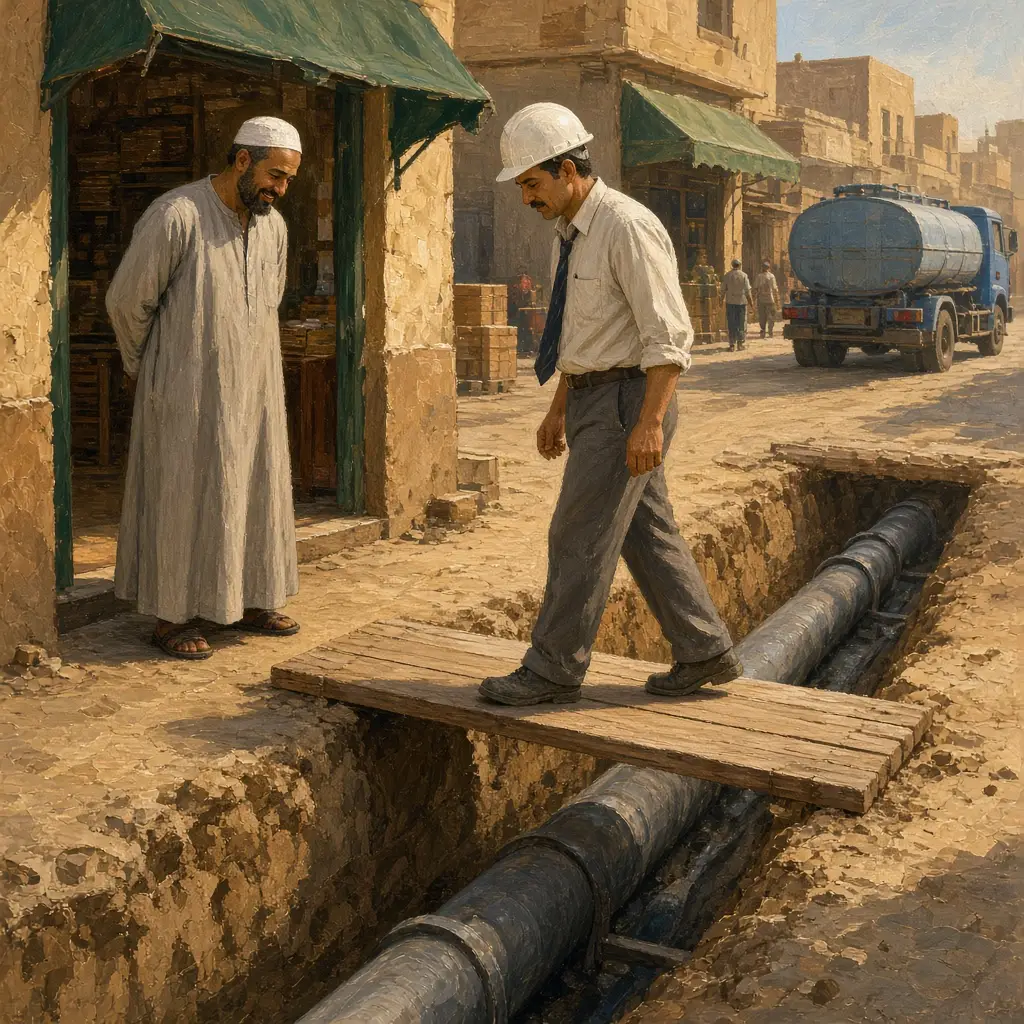
Anwar is the engineer in charge of replacing two kilometres of old water main under a busy shopping street in Tanta, Egypt. He inherits a risk register of sixty-three rows, written for the funding approval and last updated four months ago. Most rows are single words: 'ground conditions', 'public reaction', 'delays'. Nobody on site has read it since.
He rewrites it in an afternoon with the site foreman and a representative of the shopkeepers. 'Ground conditions' becomes 'The old cast-iron pipes beside the trench may crack when the soil is disturbed, cutting water to the district hospital for a day'. The network supervisor owns it, and a water tanker is arranged in advance. 'Public reaction' becomes 'Shopkeepers may block the work if their doorways are closed for more than two days'; the response is to dig in thirty-metre stretches with plank bridges to each door. The new register has twelve rows. The team reads it every Sunday morning in fifteen minutes, before the week's work begins.
Try this today Write one worry about a plan of yours as a full sentence: what might happen, what it would cause, and who would notice first.
In the Toolkit, step by step: Risk register →
Cite or share this lesson
A plain reference you can paste into notes or an essay:
Quest2Plan. “The Risk Register.” https://quest2plan.com/learn/lesson/the-risk-register. Accessed 29 November 2026.
Sources
- Risk register — What a risk register records, its usual columns, and research on how registers can become a ritual.
- Risk management — The wider process of finding, assessing and treating risks, of which the register is one tool.