
Lesson · 6 min Stretch
Three Levels of Culture
In one line Culture shows on three levels: what you can see, what people say they value, and what they take for granted.
Every workplace has rules nobody wrote down: who speaks first in a meeting, whether a deadline is a promise or a hope, what happens to the person who admits a mistake. Edgar Schein, a psychologist who taught at the MIT Sloan School of Management, set out a way to read such rules in Organizational Culture and Leadership, first published in 1985. He saw culture in three levels, from the easiest to see to the hardest.
The first level is artefacts: everything a visitor can see and hear. The open-plan floor, the dress, the posters, whether meetings start on time. Artefacts are easy to notice and hard to read, because the same one can mean different things in different places. The second level is espoused values: what people say they believe, in mission statements, strategy papers and the answers they give a newcomer. 'We value openness' is an espoused value.
The third level is basic underlying assumptions: beliefs so taken for granted that nobody states or questions them, such as 'the senior person is right' or 'raising a problem marks you as weak'. For Schein these are the core of a culture. They grew from what once worked for the group, and they now steer behaviour quietly. When a stated value and an assumption disagree, the assumption usually wins. An office with 'speak up' posters on every wall can still be a place where nobody speaks up, because everyone has seen what happens to those who do.
Reading a culture therefore means noticing the gaps between what is shown, what is said and what is done, and asking what belief would explain them. Assumptions are hard to see from the inside, which is why a newcomer's puzzled questions are so useful, and why changing a culture is slower than changing its posters.
The charter by the nurses' station
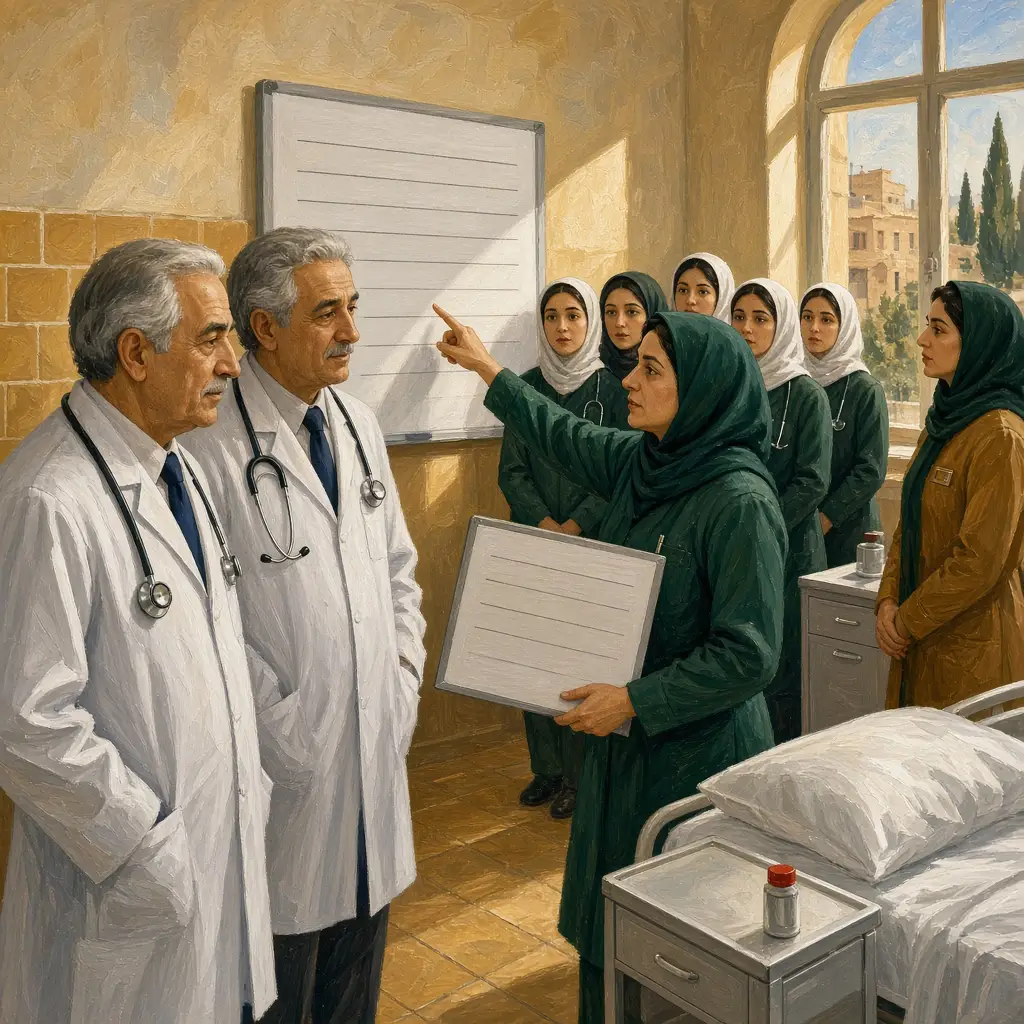
Mitra has just joined a large teaching hospital in Shiraz, Iran, as a ward manager. On her first walk round she notes the artefacts: spotless corridors, a framed charter by the nurses' station promising that any member of staff may question an order that seems unsafe, and a morning round on which the doctors talk and a line of nurses and students follows in silence.
In her second week a junior nurse tells her privately that a drug dose on a chart had looked wrong, but she said nothing on the round. Mitra asks why. 'Nobody questions the consultant in front of patients,' the nurse says, as if describing the weather. The charter is the espoused value; the assumption is that rank decides who may speak. Mitra drops her plan for a new poster. Instead she asks two senior doctors to begin each round by asking the nurse in charge what worries her, and to thank her in front of everyone when she raises a doubt.
Try this today Pick one rule that everyone at your work follows but nobody wrote down, and ask what belief would make it seem sensible.
Cite or share this lesson
A plain reference you can paste into notes or an essay:
Quest2Plan. “Three Levels of Culture.” https://quest2plan.com/learn/lesson/three-levels-of-culture. Accessed 29 November 2026.
Sources
- Edgar Schein — His life, his work at MIT Sloan and his three levels of culture: artefacts, espoused values and basic assumptions.
- Organizational culture — Definitions of organizational culture, including Schein's pattern of shared basic assumptions, and critical views.