
Lesson · 6 min Steady
Ten Minutes, Not Four Hours
In one line Shingo showed that quick changeovers make small batches pay, and that a step can be designed so a mistake cannot be made.
Small batches have an obvious enemy. If changing a machine from one job to the next takes hours, a factory will make long runs of each part to avoid changing often, and stock piles up. Shigeo Shingo, a Japanese industrial engineer who taught courses at Toyota from 1955, spent years attacking this problem. Earlier in the course, Seeing Waste counted stock as a waste; Shingo went after one of its main causes.
His method, later called single-minute exchange of die, or SMED, starts by watching a changeover and sorting each task into two kinds: internal work, which can only be done while the machine is stopped, and external work, which can be done while it still runs. Fetching tools, preparing the next die and checking parts move outside the stop; what remains is simplified with clamps, guides and fixed settings. Despite the name, the aim is a change of under ten minutes. In Shingo's own account, a large press at Toyota that took about four hours to change was brought down, step by step, to about three minutes.
His second idea, poka-yoke, means mistake-proofing. Instead of asking people to take more care, design the step so that the error cannot be made, or shows at once: a part that fits only one way round, a tray in which a left-over spring shows that one was forgotten. The term was first baka-yoke, fool-proofing, and was changed to a milder word, since the point was never that workers are fools.
Both ideas work far from factories. A plug that fits its socket only one way, a pill box with a compartment for each day, a car that will not start in gear: each makes a mistake hard to make. And anyone who lays out clothes the night before has turned internal work into external.
Go deeper
How much of the method was Shingo's own is debated. He was an outside consultant to Toyota, not one of its managers, and he is sometimes wrongly credited with inventing the whole Toyota system, which he studied, documented and taught. Some writers argue that Toyota's engineers had already shortened many changeovers before his work on its presses from 1969, and the dramatic figures come mainly from his own books. What is not in doubt is the method's spread: his book A Revolution in Manufacturing: The SMED System appeared in English in 1985 and carried the idea to factories far beyond Japan.
Clamps instead of bolts
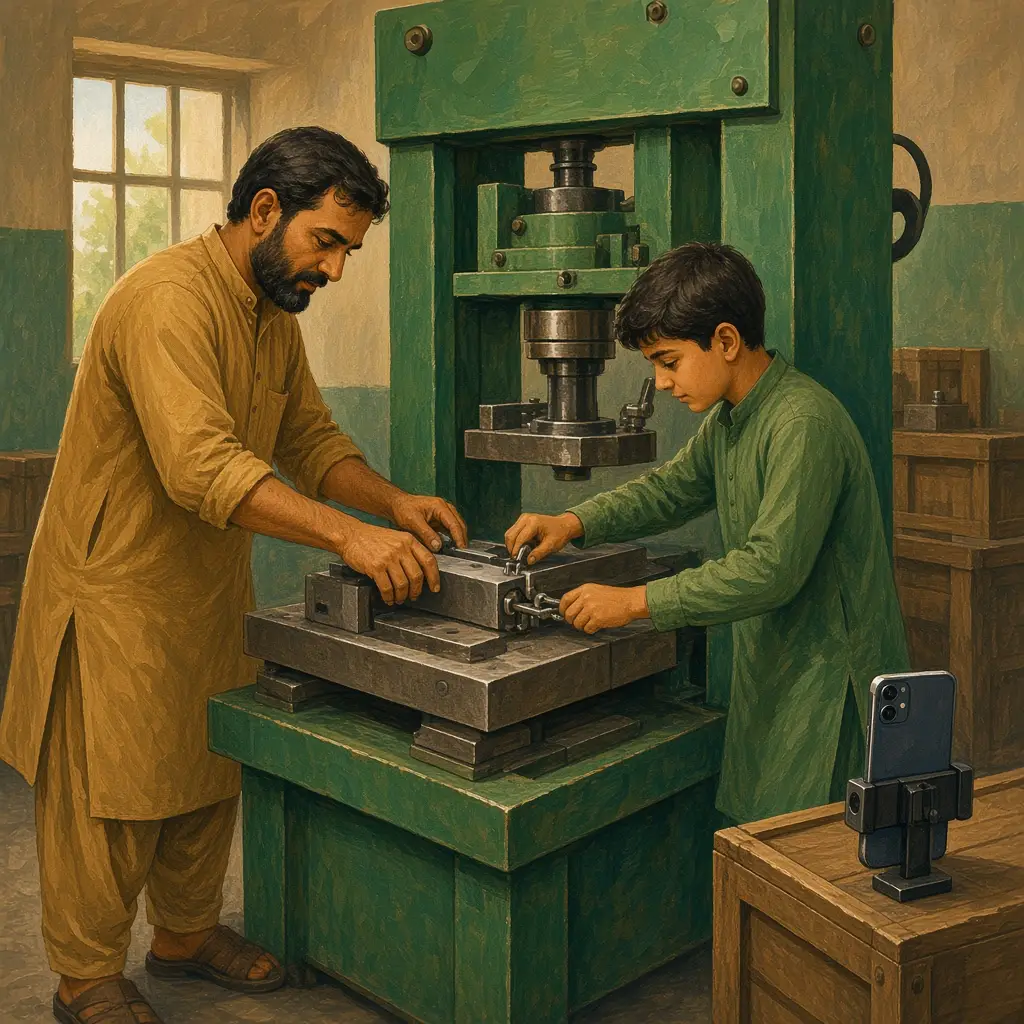
Zubair runs a workshop in Sialkot, Pakistan, that stamps steel blanks for surgical instruments. Changing the press from one shape to another takes him and his helper most of two hours, so he runs each shape for a week at a time, and the floor is stacked with crates of blanks waiting for orders.
He and his helper film one changeover and sort every task. Fetching the next die, finding the right spanner and cleaning the bolts can all happen while the press is still working, so they now do them before it stops. Bolts that took many turns are replaced by quick clamps, and a steel block marks where the die sits, so no measuring is needed. The change falls to twenty-five minutes. Zubair now runs each shape for a day, the crates shrink, and an order for an unusual shape no longer waits a week.
Try this today Pick a job you set up often, such as cooking a meal or packing a bag. Do part of the setting up beforehand and time the difference.
Cite or share this lesson
A plain reference you can paste into notes or an essay:
Quest2Plan. “Ten Minutes, Not Four Hours.” https://quest2plan.com/learn/lesson/ten-minutes-not-four-hours. Accessed 29 November 2026.
Sources
- Shigeo Shingo — His work at Toyota from 1955, die changes from 1969, his books and his part in documenting the Toyota system.
- Single-minute exchange of die — Internal and external setup, the steps of SMED and what 'single minute' means.
- Poka-yoke — Mistake-proofing, its earlier name baka-yoke, and Shingo's spring example.