
Lesson · 6 min Stretch
In the Room and on the Screen
In one line In mixed meetings the people on the screen are easily left out, so give everyone the same voice, view and record.
The hardest meeting to run well is the mixed one, with some people round a table and others joining by video. In the room, people talk over each other, glance, point at a whiteboard and carry on talking at the door. On the screen, the remote members hear a muffled room, cannot see the board and wait for a gap that never comes. Gary and Judith Olson reported that people joining by audio often could not tell who was speaking or what was being pointed at, and that those who missed something tended to phone a colleague afterwards rather than interrupt.
This is a fairness problem as well as a practical one. People who are seen tend to be credited, and managers may judge work partly by visibility. In a mixed meeting, the remote members are easily the ones whose ideas get lost.
Teams that run mixed meetings well use a few rules. One person, one screen: everyone joins on their own device, even those in the room, so every face is the same size. Someone, often a remote member, watches the remote side and calls on people; the Olsons found that teams at one aircraft maker had created a facilitator role to poll their distant sites. Notes and sketches go into a shared document all can type into, not onto a board only the room can see. Papers go out beforehand, and decisions are read back before anyone leaves the call, so nothing is settled in the corridor later.
The rules have costs. Sitting in one room behind laptops feels strange, and some of the energy of being together is lost. Some teams decide instead that each meeting is wholly in person or wholly online. Earlier in the course, Hearing Every Voice showed how quiet people can be drawn in; in a mixed meeting, distance makes everyone at the far end a little quieter.
Ten faces the same size
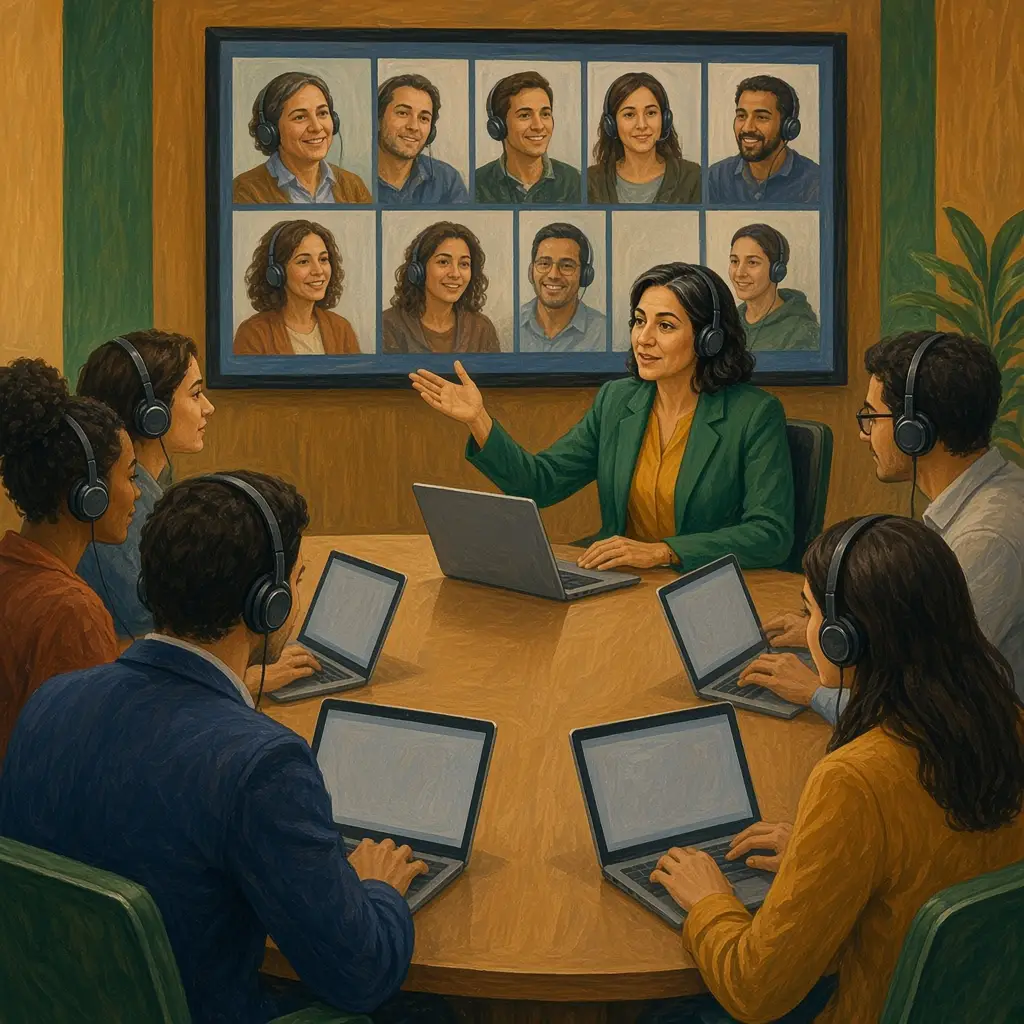
Safiya chairs the curriculum committee of a faculty at a university in Fez, Morocco. Six members meet in a seminar room; four join by video from partner universities in Dakar, Senegal, and Lyon, France. The room's camera showed the end of the table, the microphone caught whoever sat nearest, and drafts were sketched on a whiteboard the remote members could not read. In a year, the remote members had proposed almost nothing.
Safiya asked everyone in the room to join on their own laptop with headphones, and asked a lecturer in Dakar to act as co-chair, with the job of calling on remote members first on each item. The whiteboard gave way to a shared document that all ten could write in during the meeting. Each meeting ended with Safiya reading out the decisions while everyone was still connected. Over the next term, two of the three new courses the committee approved were proposed from Dakar and Lyon.
Try this today At your next mixed meeting, ask a remote person to speak first on each item, and notice what changes.
Cite or share this lesson
A plain reference you can paste into notes or an essay:
Quest2Plan. “In the Room and on the Screen.” https://quest2plan.com/learn/lesson/in-the-room-and-on-the-screen. Accessed 29 November 2026.
Sources
- Distance Matters — The Olsons' paper, including their field notes on early audio and video meetings and the facilitator role.
- Hybrid work — Work split between office and elsewhere, with its benefits and the risk of favouring those who are visible.