
Lesson · 6 min Gentle
A Second Pair of Eyes
In one line A colleague who did not do the work sees what is really there, and a review spreads knowledge too.
Nobody reads their own work well. The writer sees what they meant to write; the scientist who set up an experiment sees the steps they meant to take. A second person, who did not do the work, sees what is actually there. Peer review is the habit of asking a colleague to check a piece of work before it moves on.
Laboratories have long worked this way. Before a new test method is used on real samples, a second scientist reads it, repeats the key steps and checks the calculations. In software, a programmer's change is read by a colleague before it joins the shared code. In 1976 Michael Fagan described a formal version, the inspection, with a moderator, a reader and a recorder; most teams now use lighter reviews. In a 2001 summary of the research, Barry Boehm and Victor Basili reported that peer reviews caught around 60 per cent of faults, though results varied widely between studies.
A review can bruise. Reviewers do best when they comment on the work, not the person; ask questions rather than issue verdicts ('what happens if the sample is frozen twice?'); say which points must change and which are matters of taste; and keep each review small enough to read with care. Authors do best when they treat each comment as information, explain without defending, and remember that every fault found now is one no patient or customer will meet.
Reviews do a second job that is easy to miss: they spread knowledge. Once a colleague has read a piece of work closely, two people understand it instead of one, and the work is not lost if its author falls ill or leaves. Earlier in the course, The Humble Checklist caught the forgotten step; a review catches the mistake its author cannot see. Its cost is time, and a queue of waiting reviews can become a bottleneck of its own.
Arsenic and a stale standard
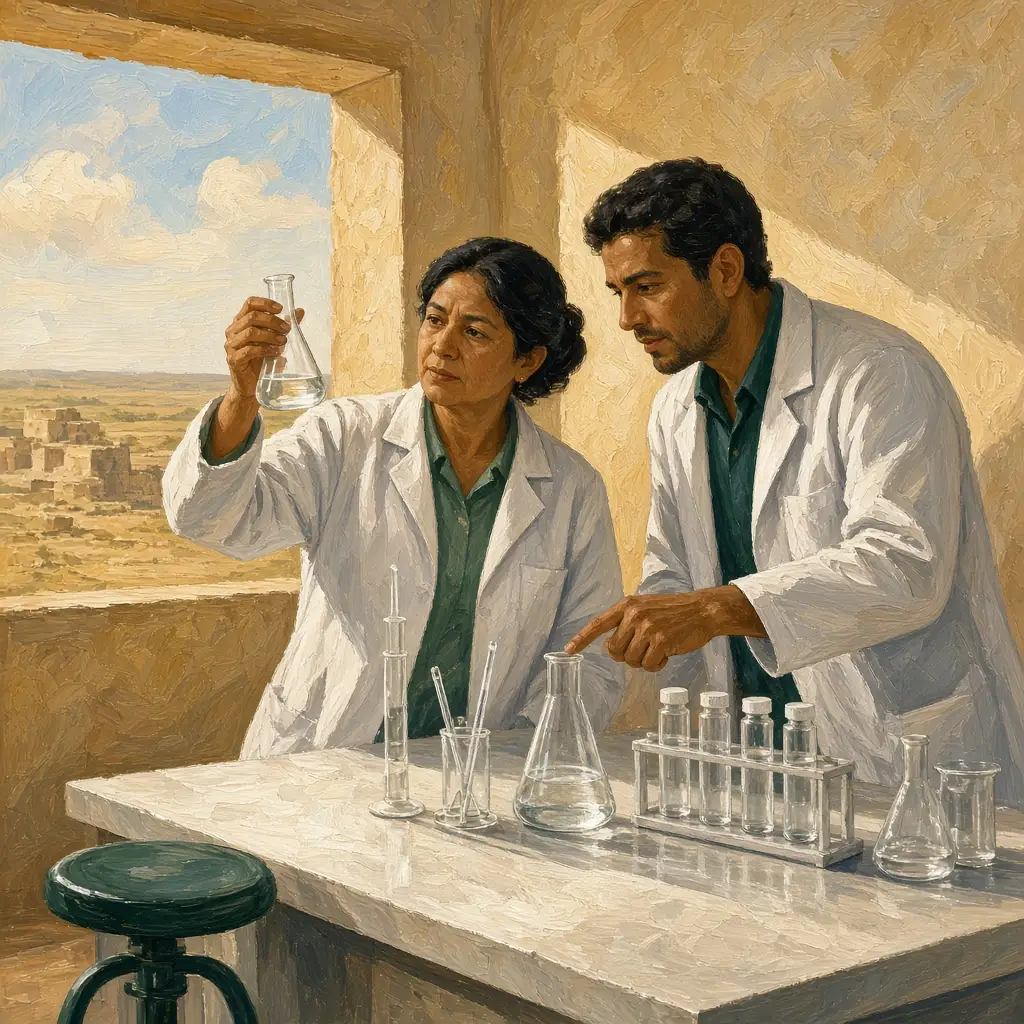
Graciela, a chemist at a water-testing laboratory in Mérida, Mexico, has written a new method for measuring arsenic in well water. Before it is used on samples from the villages, she gives it to her colleague Federico. He does not just read it; he repeats the key steps at his own bench. His notes come back as questions. Why is the calibration standard made up the day before? Has anyone checked how fast it loses strength? Graciela is irritated for an afternoon, then tests the point and finds the standard weakens enough overnight to make low readings look safe.
She changes the method to make the standard fresh each morning. Two months later she is away at a conference when a village clinic sends an urgent sample from a family with symptoms. Federico knows the method almost as well as she does, because he has worked through it line by line. The result goes back the same day.
Try this today Ask a colleague to look over one piece of your work this week, and ask them for questions rather than a verdict.
Cite or share this lesson
A plain reference you can paste into notes or an essay:
Quest2Plan. “A Second Pair of Eyes.” https://quest2plan.com/learn/lesson/a-second-pair-of-eyes. Accessed 29 November 2026.
Sources
- Code review — What code review is for, including finding faults and sharing knowledge, and what research has found.
- Fagan inspection — Michael Fagan's formal inspection method of 1976: its stages and roles.